Kalihi Entry Level Condos and What to Expect
May 21, 2026
May 21, 2026
If you’ve been priced out of many Oʻahu condo searches, Kalihi-Palama may be one of the first places that makes the numbers feel more realistic. For many buyers, the challenge is finding a home that is close to town without stretching too far beyond budget. This guide will help you understand what “entry-level” condo options in Kalihi-Palama often look like, what tradeoffs to expect, and what details deserve a closer look before you buy. Let’s dive in.
Kalihi-Palama often stands out because its condo pricing sits below the broader Oʻahu condo market. Honolulu Board of REALTORS® data showed a median condo sale price of $362,000 in Kalihi-Palama in February 2026, compared with an Oʻahu condo median of $510,000 in March 2026. The area also had 36 median days on market and sellers received 98% of original list price.
That pricing gap is a big reason first-time buyers and budget-conscious shoppers keep Kalihi-Palama on their shortlist. Realtor.com data for March 2026 showed a $375,000 median listing price in Kalihi-Palama, which was close to Downtown Honolulu at $379,000 and Dillingham at $395,000, but far below nearby Liliha-Kapalama at $744,500. If you want a central location without jumping into much higher price points, this neighborhood can make sense.
Many entry-level condo options in Kalihi-Palama tend to cluster in the high-$200,000s to mid-$300,000s. Recent and current examples in the neighborhood included 2-bedroom, 1-bath units at 1260 Richard Lane from about $260,000 to $325,000, a 1-bedroom at 1425 Liliha Street at $299,000, and a 2-bedroom at 1118 Pua Lane at $295,000. A 2-bedroom at 828 Puuhale Road was listed at $375,000.
Larger or more updated units can push higher. One renovated 3-bedroom corner walk-up at Kokea Gardens was listed at $485,000. Homes.com also describes the broader condo price range in Kalihi-Palama as roughly $190,000 to $650,000, with many buildings under 1,000 square feet.
Kalihi-Palama has an older condo inventory than many newer Oʻahu communities. Homes.com notes a neighborhood median year built of 1967, and says condo buildings here were generally built from the 1960s through the 2000s. That helps explain why buyers often see smaller layouts, older construction, and simpler amenity packages.
For you as a buyer, that usually means balancing affordability with practicality. You may get a lower purchase price, but you should expect older systems, more compact floor plans, and building rules or maintenance needs that deserve careful review. In this neighborhood, value often comes from buying in a central location and accepting fewer extras.
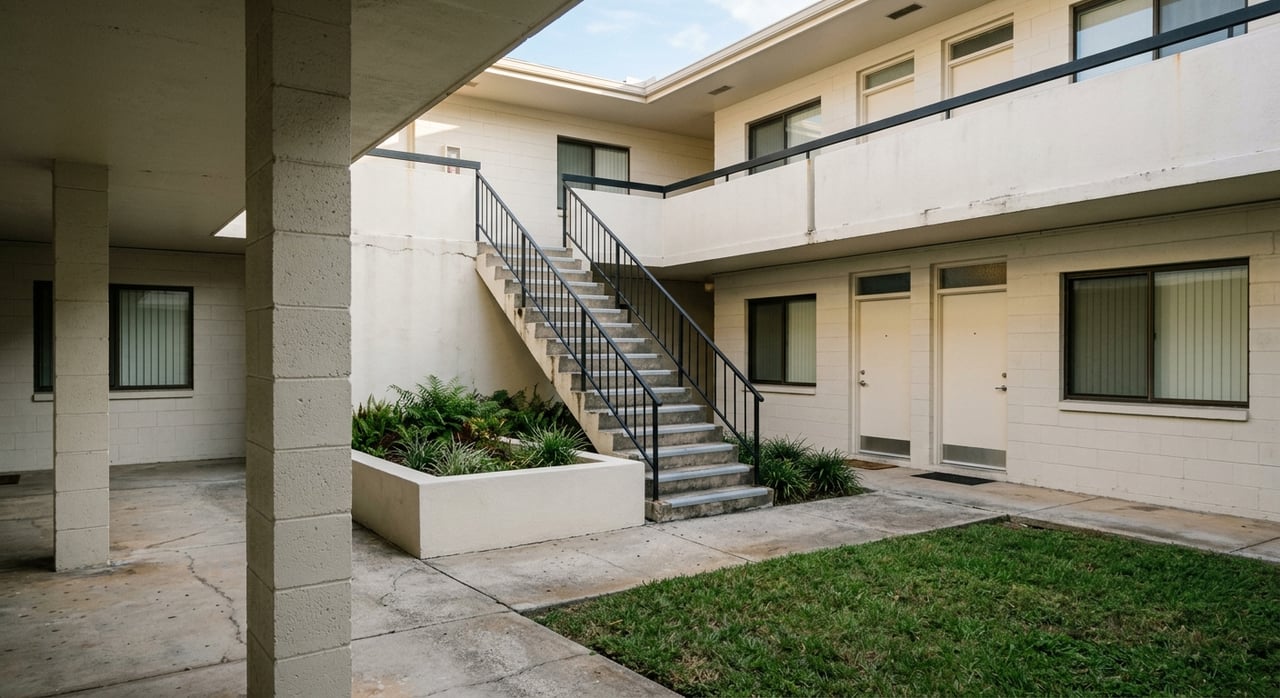
One of the most common entry-level options is the older walk-up or low-rise building. Kapalama-Uka is a useful example. It is a 3-story, 59-unit building built in 1966, with walk-up access, laundry facilities, and units that are mostly 2- to 3-bedroom layouts between 609 and 696 square feet.
This type of building usually offers a more basic ownership experience. You may see shared laundry, fewer building amenities, and simpler common areas. The appeal is often the lower price point, especially if your main goal is getting into the market.
A step up in convenience is the mid-rise secured building. 1260 Richard Lane is a strong example, with 6 stories, 164 units, and a 1977 completion date. Building features listed for that property include balconies, a ground-floor parking area, 24-hour access, a security system, and an elevator.
Recent listing examples there showed 2-bedroom units around 643 square feet priced from $260,000 to $325,000. If you want more convenience than a walk-up can offer, but still need a price below many island-wide medians, this building style may feel like a practical middle ground.
Kalihi-Palama also includes larger high-rise buildings. The City and County of Honolulu Fire Department high-rise list identifies Liliha Square as an 18-floor, 137-unit building built in 1975. Recent listing descriptions noted features such as elevators, community laundry, assigned parking, on-site management, and updated interiors in some units.
A recent 2-bedroom, 1-bath example at Liliha Square was priced at $350,000, while a 1-bedroom, 1-bath listing was $299,000. These buildings can offer more centralized management and easier access features, but they may also come with higher monthly HOA costs.
In Kalihi-Palama, affordability often comes with clear tradeoffs. Compared with newer condo projects, many entry-level units here are smaller, older, and lighter on amenities. You may not find resort-style pools, fitness centers, or large landscaped common spaces.
Instead, the value is usually in the location and entry price. If your priority is ownership in a central Honolulu area, a simpler building may still fit your goals well. The key is knowing which features are essential for your daily life and which ones you can live without.
A lower purchase price does not always mean a lower monthly cost. Hawaii’s Department of Commerce and Consumer Affairs explains that condo reserves are funds set aside for major future expenses like roofs, elevators, and other common-area repairs. If reserves are not adequate, associations may face special assessments, borrowing, or deferred maintenance.
That is especially important in an area with older condo stock. The HOA package can vary a lot from one building to another, and what is included can make a major difference in your monthly budget. Before you focus only on sticker price, compare the full monthly ownership picture.
The listing examples in Kalihi-Palama show how different one project can be from another. A 2-bedroom listing at 1118 Pua Lane said the HOA fee included electricity, gas, water, hot water, and common expenses. In a Liliha Square example, the $580 per month HOA fee included water, sewer, hot water, cable TV, and management.
Those differences matter. One building may have a higher HOA fee but cover more of your recurring expenses. Another may have a lower fee but leave you paying more utilities separately.
When you tour entry-level condos in Kalihi-Palama, it helps to ask practical questions early. In older buildings, small details can affect both your monthly budget and your day-to-day comfort.
Here are a few smart questions to keep in mind:
The Hawaii DCCA also advises buyers to review the current declaration, bylaws, and house rules carefully. Those documents may address use restrictions, pet practices, and other day-to-day ownership rules that can affect whether a building is the right fit for you.
Kalihi-Palama’s affordability is only part of the story. Its central location is a major reason buyers continue to consider it. HART says the current rail system operates to Kahauiki, also known as the Kalihi Transit Center at Middle Street, serving Kalihi and the Middle Street Transit Center.
HART reports travel times of about 4 minutes to the airport, 8 minutes to Downtown, and 12 minutes to Ala Moana from that station. HART also says Skyline’s Segment 3 is expected to add Mokauea (Kalihi) and other city-center stations, with project completion anticipated in 2030 and transfer to DTS by 2031.
For buyers who want a lower-cost foothold near urban Honolulu, transit access adds real appeal. If your routine depends on getting to central Honolulu, the airport, or nearby job centers efficiently, Kalihi-Palama can be worth a close look.
This area can be a strong match if you want to buy on Oʻahu and need to stay mindful of price. It may also work well if you are comfortable with older buildings, more compact floor plans, and a little more homework on HOA documents and maintenance history. In many cases, the tradeoff is getting a central location at a more approachable entry point.
If you want help comparing condos, reviewing neighborhood options across Oʻahu, or narrowing down which buildings fit your budget and lifestyle, Jasmin Cadiz can guide you with clear, steady support every step of the way.
Stay up to date on the latest real estate trends.
I am committed to guiding you every step of the way—whether you're buying a home, selling a property, or securing a mortgage. Whatever your needs, I've got you covered.
Jasmin Cadiz
91-1010 Shangrila St Ste 307 Kapolei HI 96707